What Is Google AI in 2026? The Business Growth Engine for the Next Decade
For over two decades, Google was a search engine. In 2026, Google is an AI-First Ecosystem. If your business is still treating Google as just a place to buy keywords or host emails, you are missing 90% of the value.
Today, Google AI is the invisible layer that powers consumer intent, technical site architecture, and automated lead generation. To grow smarter in 2026, you must understand how Google’s neural networks,specifically Gemini and the Vertex AI framework interact with your brand’s digital footprint.
In this guide, we break down how to leverage the full stack of Google’s artificial intelligence to build a predictive, scalable revenue engine.
Understanding the Google AI Stack
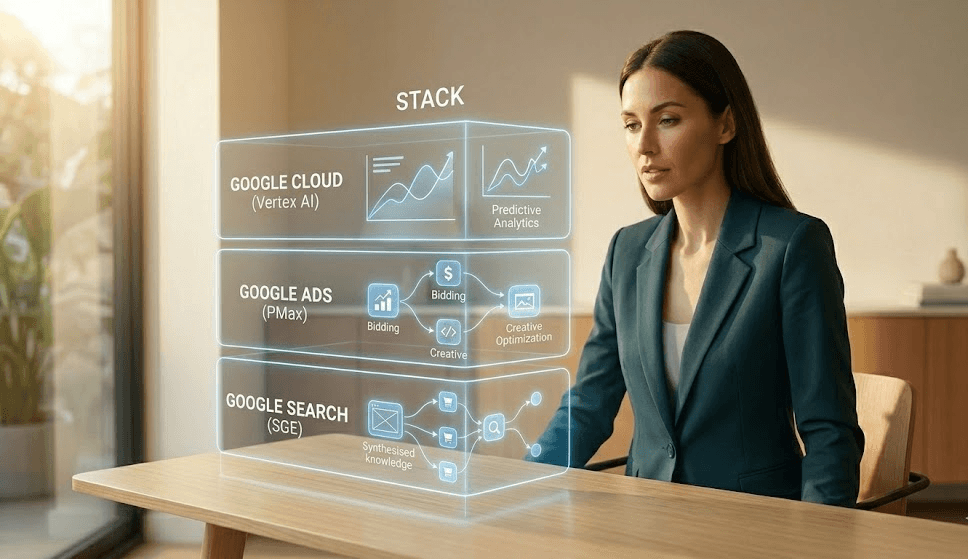
To use Google AI effectively, you have to move past the chatbot interface (Gemini) and look at the Technical Stack. For business growth, Google AI operates in three primary layers:
1. Consumer-Facing AI
The most visible shift is how customers find you. Google Search is no longer a list of blue links, it is a synthesis of information.
-
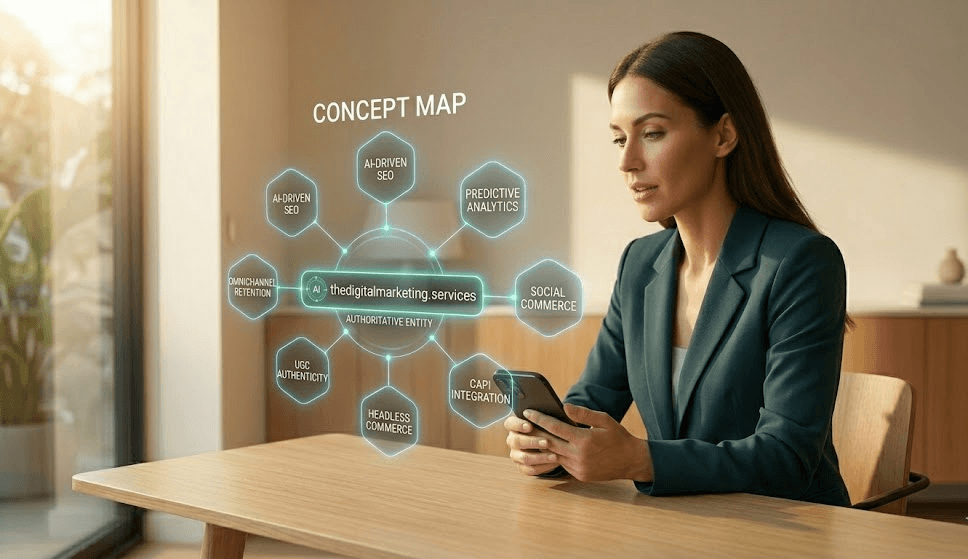
The Business Impact: You no longer rank for Keywords,you rank for Entities and Concepts. Google AI uses multi-modal processing to understand your videos, images, and text as a single authoritative entity.
2. Marketing AI
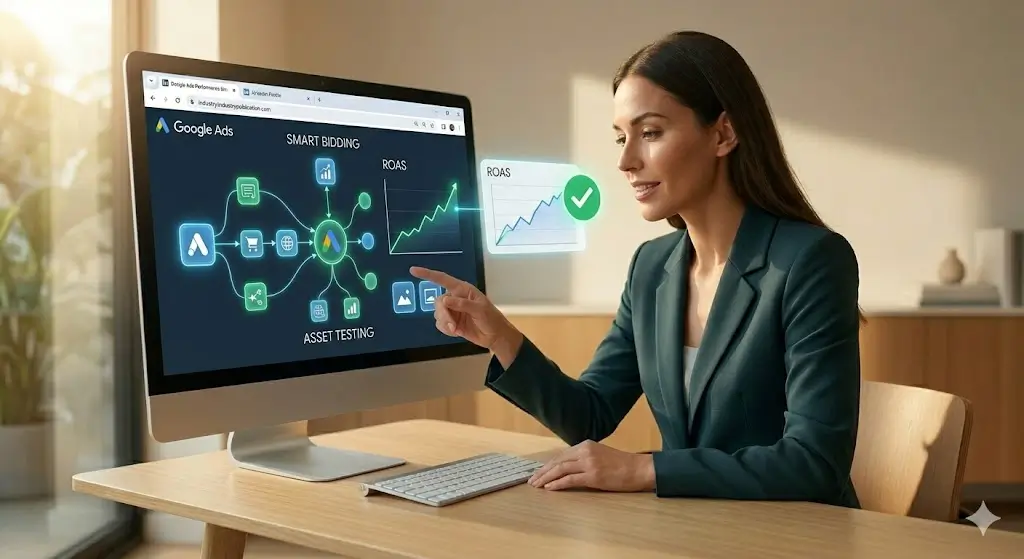
Within Google Ads, AI now makes millions of decisions per second regarding placement, bidding and creative selection.
-
The Business Impact: Performance Max (PMax) has evolved into a self-optimizing black box. Your job is no longer to manage bids; it is to provide high-quality data inputs (creative assets and conversion signals). If you haven’t mastered Google Ads Services in an AI context, your ROAS will inevitably plateaus.
3. Operational AI
This is where the Smarter Growth happens behind the scenes. Using Google’s enterprise-grade AI tools, businesses can now build custom models trained on their own proprietary data.
-
The Business Impact: Predictive analytics. Google AI can now tell you which customer is likely to churn before they do, allowing for automated re-engagement.
Strategic Implementation for ROI
Once you understand the stack, you must move into the implementation phase. This is where Google AI moves from a cool tool to a measurable asset.
4. Transitioning to Intent-Based SEO
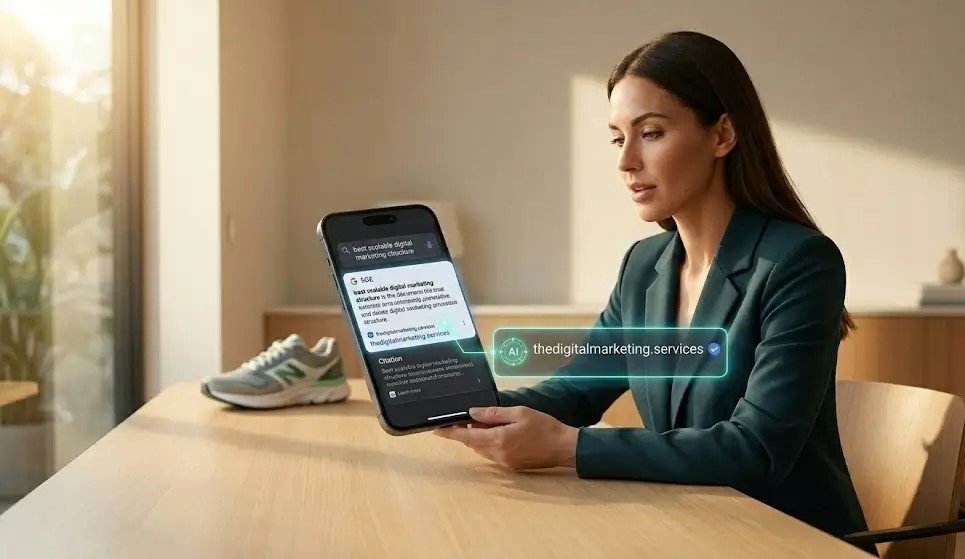
In 2026, Google AI’s NLP (Natural Language Processing) is so advanced that it understands the intent behind a query better than the user does.
-
Optimization Strategy: Stop writing for bots. Google AI rewards Information Gain ,content that provides a perspective or data point that doesn’t exist elsewhere. Our SEO services now focus on Entity Authority to ensure Google’s AI identifies your brand as the primary source of truth in your niche.
5. Leveraging Predictive Metrics in Google Analytics
Google Analytics is now fully AI-integrated. It does not just tell you what happened yesterday, it uses machine learning to provide Predictive Metrics:
-
Purchase Probability: Who is most likely to buy in the next 7 days?
-
Churn Probability: Who are you about to lose?
-
Predicted Revenue: How much will this cohort spend over their lifetime?
By acting on these AI-driven predictions, businesses can allocate budget where it has the highest mathematical chance of success.

Scalable Automation and Customer Lifetime Value (CLV)
The growth part of the title comes from automation. Google AI allows a small team to perform with the output of a global corporation.
6. Hyper-Personalization at Scale
Through the integration of Google Cloud and your CRM, you can use AI to deliver a unique experience to every user. If a user has interacted with your website development services but hasn’t booked a call, Google AI can trigger a personalized email or ad featuring a case study relevant to their specific industry.
7. Conversational Commerce with Gemini
Gemini is not just for writing blogs, it is for customer interaction. In 2026, AI-powered Concierges built on Google’s API can handle 80% of top-of-funnel customer service, qualifying leads and booking appointments into your calendar 24/7 without human intervention.
Conclusion: The AI-First Business Transformation
Google AI is no longer a futuristic concept,it is the current reality of the digital economy. Growing smarter in 2026 means moving away from manual, reactive tasks and toward a predictive, AI-augmented strategy.
Whether you are looking to dominate the search results with AI-optimized SEO or need to rebuild your storefront for the AI-search era through custom web development, the time to integrate is now.
At thedigitalmarketing.services, we do not just use AI, we help brands build the infrastructure to lead in the AI era. Is your brand an authority, or is it just an entry in a database? Let’s build your future together.

Frequently Asked Questions
1. What is the difference between Gemini and Google AI?
Think of Google AI as the entire city (the infrastructure, the cloud, the search algorithms, and the data), while Gemini is the most famous citizen. Gemini is the multimodal large language model (LLM) that you interact with directly. However, Google AI also includes invisible systems like Rank Brain for search and smart bidding for ads that do not have a chat interface.
2. How does Search Generative Experience impact my website traffic?
SGE shifts the goal from getting clicks to providing the answer. In 2026, you may see fewer clicks for broad, informational queries, but the traffic you do get will be much higher intent. Users who click through from an AI-generated summary have already been pre-sold by the AI on your expertise.
3. What is Entity-Based SEO and why does Google AI prefer it?
In the old days, Google looked for strings of text (keywords). Today, Google AI looks for things, not Strings. An Entity is a well-defined concept . By building a footprint across YouTube, LinkedIn, and high-authority blogs, you help Google’s AI map your business as a trusted entity, making you more likely to appear in AI-generated answers.
4. Can Google AI actually predict my future sales?
Yes, through Predictive Metrics in Google Analytics. By analyzing thousands of data points from past visitors, Google AI can assign a purchase probability score to your current users. This allows you to aggressively target the 5% of users who are ready to buy while saving your budget on those who are just browsing.
5. Does using Google AI in marketing make my brand feel robotic?
Only if you let the AI do the thinking instead of the execution. The most successful brands in 2026 use AI for the heavy lifting (data analysis and technical optimization) but keep humans in charge of the creative soul (storytelling and empathy). AI is the engine; you are still the driver.
6. Is Vertex AI better for businesses than the standard Gemini chatbot?
For small tasks, Gemini is perfect. However, Vertex AI is the professional choice for scaling. It allows you to build custom AI tools trained only on your business data. This means the AI understands your specific pricing, your unique service offerings, and your brand voice without leaking that data to the public.
7. Will AI-driven search eventually replace traditional SEO?
Traditional SEO isn’t being replaced; it’s being upgraded. Technical health (speed, schema, and mobile UX) is now more important than ever because if an AI cannot read your site instantly, it cannot recommend you. SEO in 2026 is simply the art of making your business AI-readable.
